






con nuestros productos
set para dejar la píldora
 Dejar la píldora sin síndrome post-píldora
Acompañamiento integral para dejar la píldora
incluyendo guía digital
Dejar la píldora sin síndrome post-píldora
Acompañamiento integral para dejar la píldora
incluyendo guía digital
In stock - Contigo en 3-5 días

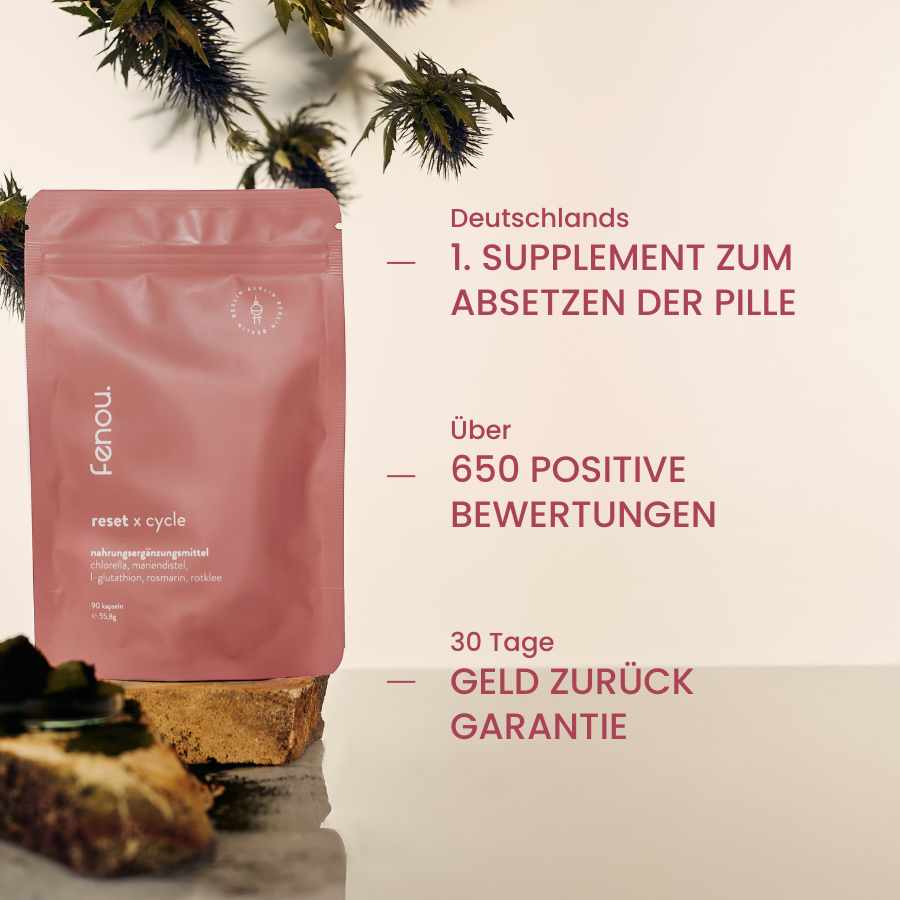
30 Tage
Geld zurück Garantie

Kostenloser
Versand ab 50€ (DE)
Esto hace que el producto sea especial.


100% Vegano
Ingredientes vegetales, sin gluten ni lactosa, sin aditivos

Testado en laboratorio en Alemania
Sin pesticidas ni metales pesados, libre de crueldad animal

Desarrollado científicamente
Basado en estudios actuales y desarrollado con expertas

Materiales reciclables
Sistema de recarga sostenible, biodegradable
FÁCIL APLICACIÓN Y DOSIFICACIÓN

CANTIDAD
Consuma 3 cápsulas al día con suficiente agua. Un sobre de reset contiene 90 cápsulas. Esto equivale a una ración mensual.

CONSUMO
Idealmente con una comida y a la misma hora.

DURACIÓN DEL CONSUMO
Para obtener el máximo efecto, recomendamos un consumo en forma de cura durante un máximo de 3 meses.
Más de 65.000 mujeres satisfechas
que pudieron solucionar tus problemas con nuestros productos y están contentos.






Ingredientes activos de alta calidad para tu salud.
Desarrollado por expertos en ginecología, naturopatía y ciencias de la nutrición. Los ingredientes seleccionados se basan en los últimos descubrimientos científicos.
|
por dosis diaria (3 cápsulas) |
%VRN* | |
| Polvo de chlorella |
150 mg |
** |
|
Extracto de semilla de cardo mariano - del cual silimarina |
100 mg 80 mg |
** ** |
| Extracto de hoja de romero |
150 mg |
** |
|
Extracto de hoja/flor de trébol rojo - del cual isoflavonas |
300 mg 24 mg |
** ** |
| L-glutatión reducido |
150 mg |
** |
|
Extracto de fruto de pimienta negra - del cual piperina |
2,1 mg 2,0 mg |
** ** |
| Biotina |
50 µg |
100 |
| Colina |
82,5 mg |
** |
| Hierro |
7 mg |
50 |
| Ácido fólico |
300 µg |
150 |
| Magnesio |
68 mg |
18 |
| Manganeso |
2 mg |
100 |
| Selenio |
55 µg |
100 |
| Zinc |
10 mg |
100 |
| Vitamina A (µg ER) |
800 µg |
100 |
| Vitamina B1 |
1,1 mg |
100 |
| Vitamina B2 |
1,4 mg |
100 |
| Niacina (Vitamina B3, mg EN) |
16 mg |
100 |
| Ácido pantoténico (Vitamina B5) |
6 mg |
100 |
| Vitamina B6 |
1,4 mg |
100 |
| Vitamina B12 |
7,5 µg |
300 |
| Vitamina C | 120 mg | 150 |
*Porcentaje de los valores de referencia de nutrientes (VRN) según el Reglamento (UE) n.º 1169/2011
**VRN no establecido
Ingredientes:
Extracto de hoja y flor de trébol rojo (8% isoflavonas) 16%, carbonato de magnesio, agente de recubrimiento: hidroxipropilmetilcelulosa (cubierta de la cápsula vegetal), bitartrato de colina, polvo de chlorella (contiene sulfitos) 8%, L-glutatión reducido 8%, extracto de hoja de romero 8%, L-ascorbato cálcico, extracto de semilla de cardo mariano (80% silimarina) 5%, citrato de hierro, citrato de zinc, nicotinamida, citrato de manganeso, D-pantotenato cálcico, acetato de retinilo, piridoxal-5'-fosfato, extracto de fruto de pimienta negra (95% piperina), riboflavina-5'-fosfato, sodio, clorhidrato de tiamina, L-metilfolato cálcico, selenito sódico, D-biotina, metilcobalamina
La chlorella es una microalga. Además de su excelente composición de nutrientes, los estudios han demostrado propiedades protectoras para el hígado, asociadas a un aumento del glutatión reducido y de la capacidad antioxidante. Utilizamos polvo de chlorella de cultivo ecológico.
El cardo mariano (Silybum marianum) pertenece a la familia de las asteráceas. Sus semillas contienen silimarina. Las propiedades antioxidantes, antiinflamatorias y hepatoprotectoras de la silimarina han sido investigadas en numerosos estudios. El extracto de semilla de cardo mariano que utilizamos contiene un 80% de silimarina.
Para el extracto de hoja de romero se utilizan las hojas del romero (Salvia rosmarinus). Tanto en experimentos con animales como en estudios clínicos se ha demostrado el efecto hepatoprotector, antioxidante y antiinflamatorio del extracto de romero. Apoya el metabolismo normal de las hormonas esteroideas estimulando la producción de bilis. El extracto de romero puede regular el metabolismo del estradiol.
El trébol rojo (Trifolium pratense) pertenece a la familia de las leguminosas y es rico en isoflavonas. Se utiliza mucho en ginecología. En estudios con animales y humanos, el trébol rojo ha demostrado regular el equilibrio de estrógenos y progesterona, aliviando así los síntomas de la menopausia y reduciendo el riesgo de cáncer de mama. Además, parece influir positivamente en el metabolismo de la glucosa.
El glutatión es un tripéptido que constituye uno de los antioxidantes más importantes de nuestro organismo. Lo utilizamos en su forma reducida y activa. Actúa como captador de radicales libres en todas las células del cuerpo y se encuentra en concentraciones especialmente elevadas en el hígado, donde es responsable de la función desintoxicante. La necesidad de glutatión puede aumentar en casos de mayor estrés oxidativo y alta actividad hepática, por ejemplo, al tomar medicamentos. En los alimentos, el glutatión se encuentra principalmente en frutas y verduras. El espárrago, en particular, se cita como una muy buena fuente."
Se dice que el fruto de la pimienta negra (Piper nigrum) mejora la biodisponibilidad y la tasa de absorción de diversas sustancias farmacológicamente activas, por lo que a menudo se utiliza en el Ayurveda como acompañamiento.
La biotina es un componente importante de muchas enzimas. Por ello, una carencia se manifiesta de diferentes maneras. La caída del cabello, los problemas cutáneos e incluso los trastornos psicológicos pueden ser, por ejemplo, consecuencia de una carencia de biotina. La biotina está presente en muchos alimentos vegetales, como las legumbres, la levadura de cerveza, los cereales integrales, los champiñones o el aguacate.
La colina es una vitamina hidrosoluble clasificada entre las vitaminas del grupo B. Desempeña un papel importante en muchos procesos metabólicos del organismo, incluido el hígado. Puede ser sintetizada por el propio cuerpo, pero no en cantidad suficiente. La colina se encuentra en alimentos como la yema de huevo, la soja, el hígado y los frutos secos.
El hierro es un cofactor importante para muchas enzimas y desempeña un papel fundamental en la función de los glóbulos rojos. A través de la menstruación, se pierden cantidades importantes de hierro regularmente. Importantes fuentes vegetales de hierro son los cereales integrales, las legumbres, los frutos secos, las semillas, las verduras de hoja verde oscuro y los frutos secos deshidratados. Es importante no consumirlos junto con alimentos que inhiben su absorción (por ejemplo, café, té negro, té verde). Es mejor combinarlos con alimentos ricos en vitamina C o ácidos frutales.
El ácido fólico solo se almacena en pequeñas cantidades en el cuerpo. Por ello, una baja ingesta se nota en poco tiempo. Son especialmente comunes síntomas como cansancio, irritabilidad, ansiedad o estados de ánimo depresivos. La píldora aumenta la necesidad de ácido fólico. Tras dejar de tomarla, pueden pasar hasta 3 meses hasta alcanzar un nivel sanguíneo normal. Esto es especialmente importante si la píldora se deja por deseo de embarazo. El ácido fólico se encuentra en muchos alimentos vegetales como legumbres, cereales integrales, germen de cereales, verduras de hoja verde oscuro, col y levadura de cerveza. Como es una vitamina muy sensible, intenta incluir en tu dieta alimentos lo más frescos y naturales posible.
El magnesio desempeña un papel importante en la función del sistema nervioso. Su demanda aumenta con la toma de la píldora, lo que conlleva un mayor riesgo de osteoporosis, migrañas o trombosis. Los calambres menstruales pueden aliviarse bien con magnesio. Especialmente en combinación con la vitamina B6, se pueden reducir los síntomas del SPM como los cambios emocionales. El magnesio se encuentra en muchos alimentos vegetales. Buenas fuentes son las legumbres, los cereales integrales, las semillas, los frutos secos, las verduras de hoja verde oscuro y también el agua mineral.
El manganeso es uno de los minerales que a menudo falta en la dieta y que afecta especialmente al sistema de las hormonas sexuales. La deficiencia de manganeso puede, por ejemplo, reducir la fertilidad e influir en la salud de la piel y el tejido conectivo. El manganeso, en combinación con el calcio, puede reducir los síntomas del SPM. Alimentos como los cereales integrales, los copos de avena, las legumbres, los frutos secos, el germen de cereales y las semillas son buenas fuentes de manganeso.
El selenio forma parte de los procesos antioxidantes del cuerpo y posibilita la función de las hormonas tiroideas. Una deficiencia puede manifestarse de muchas formas; una consecuencia pueden ser los trastornos de fertilidad. Los suelos alemanes son más bien pobres en selenio; cantidades significativas se encuentran, por ejemplo, en las nueces de Brasil, las legumbres y los cereales integrales.
El zinc desempeña un papel fundamental en todo el metabolismo. Es especialmente importante su función como cofactor en innumerables vías metabólicas, en el sistema inmunitario, en la formación de hormonas sexuales y en el mantenimiento saludable de la piel, el cabello, las uñas, las mucosas, etc. En general, el aporte de zinc se considera crítico. La necesidad de zinc aumenta aún más con la toma de la píldora. Buenas fuentes vegetales de zinc son las legumbres, los cereales integrales, el maíz, los copos de avena, los frutos secos y las verduras de hoja verde oscuro.
La vitamina A es necesaria para la síntesis propia de las hormonas sexuales y es especialmente importante para la función protectora saludable de la piel, la formación de tejidos (por ejemplo, en el tracto urinario y genital) y el funcionamiento saludable de las mucosas. La necesidad de vitamina A puede aumentar debido a varios factores, como el estrés, las inflamaciones, la alta exposición solar, el tabaco o el consumo de alcohol. En los alimentos vegetales, la vitamina A se encuentra como precursor en forma de carotenoides. Estos se encuentran en todo tipo de frutas y verduras, especialmente, por ejemplo, en batatas, zanahorias, espinacas o también albaricoques o melocotones.
La necesidad de las vitaminas B individuales aumenta con la toma de la píldora. La vitamina B1 tiene una baja capacidad de almacenamiento en el cuerpo y, por tanto, debe suministrarse diariamente. Es importante para el funcionamiento del sistema nervioso y procesos psicológicos saludables, ayuda a una cicatrización funcional y contribuye así a una piel sana. Puedes encontrar vitamina B1 en levadura de cerveza, cereales integrales, semillas oleaginosas como las de girasol o calabaza, pero también en legumbres y patatas.
La vitamina B2 es un cofactor importante en el metabolismo de los 3 nutrientes principales: proteínas, hidratos de carbono y grasas. Su necesidad aumenta con la toma de la píldora. Se sospecha que la deficiencia de vitamina B2 podría ser un factor contribuyente de migrañas y dolores de cabeza al tomar la píldora. Buenas fuentes de vitamina B2 son los champiñones, la levadura de cerveza, las verduras de hoja verde oscuro y los frutos secos. La vitamina B2 es relativamente sensible al calor, pero se disuelve en agua durante la preparación. Así que aprovecha también el agua de cocción de las verduras, por ejemplo, como salsa o caldo.
La niacina desempeña un papel fundamental como antioxidante, especialmente en el hígado. Una deficiencia puede influir negativamente tanto en la salud de la piel como en la función del sistema nervioso. Las consecuencias pueden ser, por ejemplo, dolores de cabeza, ansiedad, fatiga, etc. La niacina puede formarse en el cuerpo a partir del triptófano. El triptófano se encuentra en alimentos ricos en proteínas como frutos secos, legumbres, cereales integrales y verduras de hoja verde oscuro. La niacina también se encuentra directamente en legumbres como cacahuetes, anacardos o, por ejemplo, champiñones.
El ácido pantoténico participa en la formación de hormonas sexuales y hormonas esteroideas como el cortisol. De este modo, desempeña un papel en el equilibrio hormonal y la reacción del cuerpo al estrés. Una deficiencia se manifiesta, entre otras cosas, en fatiga y mala cicatrización de heridas. El ácido pantoténico se encuentra en muchos alimentos como legumbres, cereales integrales, verduras de hoja verde oscuro o frutos secos.
La vitamina B6 tiene una gran influencia en el metabolismo de la serotonina y, por tanto, en el riesgo de depresión. Permite la transformación de triptófano en niacina, es crucial para unas células nerviosas sanas, un metabolismo de la glucosa funcional y un sistema vascular sano. Su necesidad aumenta con la toma de la píldora y su deficiencia está relacionada con un mayor riesgo de trombosis. Un alto consumo de alimentos animales ricos en proteínas aumenta adicionalmente la necesidad de vitamina B6. Buenas fuentes vegetales son las patatas, los plátanos, las legumbres, la levadura de cerveza, las verduras de hoja verde oscuro y los frutos secos. Asegúrate de incluir también alimentos crudos en tu dieta, ya que la vitamina B6 es muy sensible al calor.
La vitamina C es una de las vitaminas cuya necesidad aumenta con la toma de preparados que contienen estrógenos, como la píldora anticonceptiva. Necesitas vitamina C para diversos procesos metabólicos, como el sistema inmunitario, la función tiroidea, la función hepática y para la formación saludable de la piel, el cabello y el tejido conectivo. La vitamina C tiene propiedades antioxidantes y antiinflamatorias. Puedes encontrarla en muchas frutas y verduras, sobre todo en frutos silvestres como el espino amarillo o el escaramujo, pero también en cítricos, coles e incluso patatas.

Organic chlorella powder
Chlorella is a microalgae. In addition to their good nutritional composition, studies have also shown liver-protective properties, which are associated with an increase in reduced glutathione and antioxidant capacity. We use organically grown chlorella powder.
Organic chlorella powder
Chlorella is a microalgae. In addition to their good nutritional composition, studies have also shown liver-protective properties, which are associated with an increase in reduced glutathione and antioxidant capacity. We use organically grown chlorella powder.

Milk thistle seed extract
Milk thistle (Silybum marianum) belongs to the daisy family. Their seeds contain the substance silymarin. The antioxidant, anti-inflammatory and liver-protective properties of silymarin have been researched in numerous studies. The milk thistle seed extract we use contains 80% silymarin.
Milk thistle seed extract
Milk thistle (Silybum marianum) belongs to the daisy family. Their seeds contain the substance silymarin. The antioxidant, anti-inflammatory and liver-protective properties of silymarin have been researched in numerous studies. The milk thistle seed extract we use contains 80% silymarin.

ROSEMARY LEAF EXTRACT
The leaves of rosemary (Salvia rosmarinus) are used for the rosemary leaf extract.
ROSEMARY LEAF EXTRACT
The leaves of rosemary (Salvia rosmarinus) are used for the rosemary leaf extract.

Red clover extract
Red clover (Trifolium pratense) belongs to the legume family and is rich in isoflavones. It is widely used in gynecology. In animal and human studies, red clover was able to regulate estrogen and progesterone levels, thereby alleviating menopausal symptoms and reducing the risk of breast cancer. Red clover also appears to have a positive effect on glucose metabolism.
Red clover extract
Red clover (Trifolium pratense) belongs to the legume family and is rich in isoflavones. It is widely used in gynecology. In animal and human studies, red clover was able to regulate estrogen and progesterone levels, thereby alleviating menopausal symptoms and reducing the risk of breast cancer. Red clover also appears to have a positive effect on glucose metabolism.

L-Glutathione, reduced
Glutathione is a tripeptide that represents one of the most important antioxidants in our body. We use it in its reduced, active form. It acts as a scavenger of free radicals in all body cells and is present in particularly high concentrations in the liver. There, it is responsible for the liver's detoxification function. The need for glutathione can be increased in cases of elevated oxidative stress and increased liver activity. z.B...when taking medication. Glutathione is found primarily in fruits and vegetables. Asparagus is particularly well-known as a very good source.
L-Glutathione, reduced
Glutathione is a tripeptide that represents one of the most important antioxidants in our body. We use it in its reduced, active form. It acts as a scavenger of free radicals in all body cells and is present in particularly high concentrations in the liver. There, it is responsible for the liver's detoxification function. The need for glutathione can be increased in cases of elevated oxidative stress and increased liver activity. z.B...when taking medication. Glutathione is found primarily in fruits and vegetables. Asparagus is particularly well-known as a very good source.

BLACK PEPPER FRUIT EXTRACT
The fruit of the black pepper (Piper nigrum) is said to improve the bioavailability and absorption rate of various pharmacologically active substances and is therefore z.B. also often used as a complementary treatment in Ayurveda.
BLACK PEPPER FRUIT EXTRACT
The fruit of the black pepper (Piper nigrum) is said to improve the bioavailability and absorption rate of various pharmacologically active substances and is therefore z.B. also often used as a complementary treatment in Ayurveda.

Biotin
Biotin is an important component of many enzymes. A deficiency can therefore manifest itself in various ways. Hair loss, skin problems, and even psychological issues can occur. z.BThese can be consequences of a biotin deficiency. Biotin is found in many plant-based foods. z.B. in legumes, nutritional yeast, whole grains, mushrooms or avocado.
Biotin
Biotin is an important component of many enzymes. A deficiency can therefore manifest itself in various ways. Hair loss, skin problems, and even psychological issues can occur. z.BThese can be consequences of a biotin deficiency. Biotin is found in many plant-based foods. z.B. in legumes, nutritional yeast, whole grains, mushrooms or avocado.
Choline
Choline is a nutrient that must be obtained through diet, but is often inadequate in people with a uterus. Choline plays an important role in many metabolic processes, especially in supporting the liver in its function in detoxifying foreign substances, such as synthetic hormones. A choline deficiency negatively affects inflammatory parameters. These are also increased when taking pills. Choline is mainly found in animal foods, but legumes (especially soybeans), seeds and nuts are also good sources.
Choline
Choline is a nutrient that must be obtained through diet, but is often inadequate in people with a uterus. Choline plays an important role in many metabolic processes, especially in supporting the liver in its function in detoxifying foreign substances, such as synthetic hormones. A choline deficiency negatively affects inflammatory parameters. These are also increased when taking pills. Choline is mainly found in animal foods, but legumes (especially soybeans), seeds and nuts are also good sources.

Iron
Iron is an important cofactor for many enzymes and plays a significant role in the function of red blood cells. Large amounts of iron are regularly lost through menstruation. Important plant-based sources of iron include whole grains, legumes, nuts, seeds and kernels, dark green leafy vegetables, and dried fruit. It is important that these are not consumed in combination with foods that inhibit iron absorption (z.B(e.g., coffee, black tea, green tea). It is better to combine it with foods rich in vitamin C or fruit acids.
Iron
Iron is an important cofactor for many enzymes and plays a significant role in the function of red blood cells. Large amounts of iron are regularly lost through menstruation. Important plant-based sources of iron include whole grains, legumes, nuts, seeds and kernels, dark green leafy vegetables, and dried fruit. It is important that these are not consumed in combination with foods that inhibit iron absorption (z.B(e.g., coffee, black tea, green tea). It is better to combine it with foods rich in vitamin C or fruit acids.

FOLIC ACID
Folic acid is only stored in small amounts in the body. The pill increases the need for folic acid. After stopping it, it can take up to 3 months until normal blood levels are reached. This is particularly important if you stop taking the pill because you want to have children. Folic acid is found in many plant foods such as legumes, whole grains, cereal germs, dark green leafy vegetables, cabbage and nutritional yeast. Since folic acid is a very sensitive vitamin, you should make sure to include as fresh and unprocessed foods as possible in your diet.
FOLIC ACID
Folic acid is only stored in small amounts in the body. The pill increases the need for folic acid. After stopping it, it can take up to 3 months until normal blood levels are reached. This is particularly important if you stop taking the pill because you want to have children. Folic acid is found in many plant foods such as legumes, whole grains, cereal germs, dark green leafy vegetables, cabbage and nutritional yeast. Since folic acid is a very sensitive vitamin, you should make sure to include as fresh and unprocessed foods as possible in your diet.

MAGNESIUM
Magnesium plays an important role in the functioning of the nervous system. Magnesium is found in many plant foods. Good sources include legumes, whole grains, seeds, seeds, nuts, dark green leafy vegetables and mineral water.
MAGNESIUM
Magnesium plays an important role in the functioning of the nervous system. Magnesium is found in many plant foods. Good sources include legumes, whole grains, seeds, seeds, nuts, dark green leafy vegetables and mineral water.

Manganese
Manganese is one of the minerals that are often lacking in our diets and that has a particularly strong effect on the sex hormone system. Manganese deficiency can z.BManganese can reduce fertility and affect the health of skin and connective tissue. In combination with calcium, manganese may reduce PMS symptoms. Foods such as whole grains, oatmeal, legumes, nuts, wheat germ, and seeds are good sources of manganese.
Manganese
Manganese is one of the minerals that are often lacking in our diets and that has a particularly strong effect on the sex hormone system. Manganese deficiency can z.BManganese can reduce fertility and affect the health of skin and connective tissue. In combination with calcium, manganese may reduce PMS symptoms. Foods such as whole grains, oatmeal, legumes, nuts, wheat germ, and seeds are good sources of manganese.

Selenium
Selenium is involved in the body's antioxidant processes and enables the function of thyroid hormones. A deficiency can manifest itself in many ways, and fertility problems can be a consequence. German soils are rather low in selenium; significant amounts are found in [missing information]. z.B. in Brazil nuts, legumes and whole grains.
Selenium
Selenium is involved in the body's antioxidant processes and enables the function of thyroid hormones. A deficiency can manifest itself in many ways, and fertility problems can be a consequence. German soils are rather low in selenium; significant amounts are found in [missing information]. z.B. in Brazil nuts, legumes and whole grains.

ZINC
Zinc has a large role in the overall metabolism. Its function as a cofactor in countless metabolic pathways, in the immune system, in the formation of sex hormones and the healthy structure of skin, hair, nails, mucous membranes, etc. is particularly important. In general, zinc intake is considered critical. The need for zinc is further increased by taking the pill. Good plant sources of zinc include legumes, whole grains, corn, oat flakes, nuts and dark green leafy vegetables.
ZINC
Zinc has a large role in the overall metabolism. Its function as a cofactor in countless metabolic pathways, in the immune system, in the formation of sex hormones and the healthy structure of skin, hair, nails, mucous membranes, etc. is particularly important. In general, zinc intake is considered critical. The need for zinc is further increased by taking the pill. Good plant sources of zinc include legumes, whole grains, corn, oat flakes, nuts and dark green leafy vegetables.

Vitamin A
Vitamin A is necessary for the body's own synthesis of sex hormones and is especially important for the healthy protective function of the skin and the formation of tissues. u.a...in the urinary and genital tract and the healthy function of the mucous membranes. The need for vitamin A can be increased by various factors, z.BStress, inflammation, high sun exposure, smoking, or alcohol consumption can all contribute to vitamin A deficiency. Vitamin A is found in plant-based foods as a precursor in the form of carotenoids. These are found in all kinds of fruits and vegetables, especially... z.B. in sweet potatoes, carrots, spinach, or even apricots or peaches.
Vitamin A
Vitamin A is necessary for the body's own synthesis of sex hormones and is especially important for the healthy protective function of the skin and the formation of tissues. u.a...in the urinary and genital tract and the healthy function of the mucous membranes. The need for vitamin A can be increased by various factors, z.BStress, inflammation, high sun exposure, smoking, or alcohol consumption can all contribute to vitamin A deficiency. Vitamin A is found in plant-based foods as a precursor in the form of carotenoids. These are found in all kinds of fruits and vegetables, especially... z.B. in sweet potatoes, carrots, spinach, or even apricots or peaches.

Vitamin B2
Vitamin B2 is an important cofactor in the metabolism of the three main nutrients: protein, carbohydrates, and fat. Its requirement is increased by taking the birth control pill. A vitamin B2 deficiency is suspected of contributing to migraines and headaches in pill-taking patients. Good sources of vitamin B2 include mushrooms, nutritional yeast, dark green leafy vegetables, and nuts. Vitamin B2 is relatively sensitive to heat but dissolves in water during cooking. Therefore, also use the cooking water from vegetables. z.B. as a sauce or broth.
Vitamin B2
Vitamin B2 is an important cofactor in the metabolism of the three main nutrients: protein, carbohydrates, and fat. Its requirement is increased by taking the birth control pill. A vitamin B2 deficiency is suspected of contributing to migraines and headaches in pill-taking patients. Good sources of vitamin B2 include mushrooms, nutritional yeast, dark green leafy vegetables, and nuts. Vitamin B2 is relatively sensitive to heat but dissolves in water during cooking. Therefore, also use the cooking water from vegetables. z.B. as a sauce or broth.

Vitamin B3 (niacin)
Niacin plays a major role as an antioxidant, especially in the liver. A deficiency can negatively affect both skin health and the function of the nervous system. Consequences can include... z.BSymptoms of niacin deficiency include headaches, anxiety, fatigue, etc. Niacin can be produced in the body from tryptophan. Tryptophan is found in protein-rich foods such as nuts, legumes, whole grains, and dark green leafy vegetables. Niacin is also found directly in legumes such as peanuts, cashews, or... z.BMushrooms.
Vitamin B3 (niacin)
Niacin plays a major role as an antioxidant, especially in the liver. A deficiency can negatively affect both skin health and the function of the nervous system. Consequences can include... z.BSymptoms of niacin deficiency include headaches, anxiety, fatigue, etc. Niacin can be produced in the body from tryptophan. Tryptophan is found in protein-rich foods such as nuts, legumes, whole grains, and dark green leafy vegetables. Niacin is also found directly in legumes such as peanuts, cashews, or... z.BMushrooms.

VITAMIN B5 (PANTOTHENIC ACID)
Pantothenic acid is involved in the synthesis of sex hormones and steroid hormones such as cortisol. It therefore plays a role in hormonal balance and the body's stress response. A deficiency manifests itself in u.aSymptoms include fatigue and poor wound healing. Pantothenic acid is found in many foods such as legumes, whole grains, dark green leafy vegetables, and nuts.
VITAMIN B5 (PANTOTHENIC ACID)
Pantothenic acid is involved in the synthesis of sex hormones and steroid hormones such as cortisol. It therefore plays a role in hormonal balance and the body's stress response. A deficiency manifests itself in u.aSymptoms include fatigue and poor wound healing. Pantothenic acid is found in many foods such as legumes, whole grains, dark green leafy vegetables, and nuts.

VITAMIN B6
Vitamin B6 plays a role in serotonin metabolism. A high consumption of animal-based, protein-rich foods additionally increases the need for vitamin B6. Good plant sources include potatoes, bananas, legumes, nutritional yeast, dark green leafy vegetables and nuts. Make sure to include raw vegetables in your diet, as vitamin B6 is very sensitive to heat.
VITAMIN B6
Vitamin B6 plays a role in serotonin metabolism. A high consumption of animal-based, protein-rich foods additionally increases the need for vitamin B6. Good plant sources include potatoes, bananas, legumes, nutritional yeast, dark green leafy vegetables and nuts. Make sure to include raw vegetables in your diet, as vitamin B6 is very sensitive to heat.

Vitamin C
Vitamin C is one of the vitamins whose need is increased by taking estrogen-containing preparations such as the birth control pill. You need vitamin C for various metabolic processes. u.aVitamin C supports the immune system, thyroid function, liver function, and the healthy development of skin, hair, and connective tissue. You can find vitamin C in many fruits and vegetables, especially wild fruits like sea buckthorn or rosehips, but also in citrus fruits, cabbage, and even potatoes.
Vitamin C
Vitamin C is one of the vitamins whose need is increased by taking estrogen-containing preparations such as the birth control pill. You need vitamin C for various metabolic processes. u.aVitamin C supports the immune system, thyroid function, liver function, and the healthy development of skin, hair, and connective tissue. You can find vitamin C in many fruits and vegetables, especially wild fruits like sea buckthorn or rosehips, but also in citrus fruits, cabbage, and even potatoes.

VITAMIN B12
Vitamin B12 has a relatively high storage capacity in our body. The need is increased due to a purely plant-based diet, absorption disorders or taking the pill. Vegan users in particular should pay attention to sufficient intake, as vitamin B12 is important for a healthy nervous system, a functioning immune system and the growth of cells and DNA. There are no safe amounts of available vitamin B12 in plant foods. If you don't eat animal foods, it's important to use a nutrient supplement and/or fortified products. We use methylcobalamin in our products.
VITAMIN B12
Vitamin B12 has a relatively high storage capacity in our body. The need is increased due to a purely plant-based diet, absorption disorders or taking the pill. Vegan users in particular should pay attention to sufficient intake, as vitamin B12 is important for a healthy nervous system, a functioning immune system and the growth of cells and DNA. There are no safe amounts of available vitamin B12 in plant foods. If you don't eat animal foods, it's important to use a nutrient supplement and/or fortified products. We use methylcobalamin in our products.
Preguntas frecuentes
Todos nuestros productos son 100% veganos.
Nuestros productos son esencialmente libres de gluten. Sin embargo, debido a razones de producción, no se puede descartar por completo la contaminación cruzada con alérgenos.
Puede encontrar las recomendaciones de dosis exactas para cada producto en la parte posterior del envase o más arriba, en la sección "Uso". Recomendamos consumir nuestros productos con suficiente líquido, idealmente con una comida y aproximadamente a la misma hora del día.
Generalmente, puedes combinar nuestros productos. Reset se puede combinar con todos los productos y debe consumirse durante un máximo de 3 meses, mientras que los demás productos deben consumirse de forma continua hasta que se resuelva el desequilibrio hormonal. Solo recomendamos pausar el consumo de los demás productos mientras tomas Relief and Mood. Los minerales y vitaminas que contiene Relief ya están en dosis altas. Una vez que hayas terminado Relief and Mood, puedes continuar con los demás productos como de costumbre.
Si no estás satisfecha con el efecto de un producto, tienes la opción de que se te reembolse el precio de compra (excl. gastos de envío) una sola vez hasta 100 días después de la compra. Para ello, ponte en contacto con nuestro servicio de atención al cliente a través de support@fenou.de. Te enviaremos una etiqueta de devolución con la que podrás enviarnos de vuelta tanto los productos cerrados como los abiertos. Te reembolsaremos el importe de la compra una vez que el producto haya sido procesado en el almacén. Ten en cuenta que los principios activos de origen vegetal pueden tardar una media de 3 meses en desplegar todo su efecto. Si compras varias bolsas del mismo producto, por favor, en aras de la sostenibilidad, abre solo una de ellas. Lamentablemente, tenemos que desechar los envases abiertos.